
Food Allergens in Restaurants: Legal Duties in Romania
In the HoReCa industry, compliance with allergen legislation is not optional — it is a strict legal obligation with direct impact on customer safety and financial risks for business. If you have a restaurant, café or fast-food, you must clearly understand what the law says and how to correctly apply these rules, especially in the context of digital menus.
In this article I explain to you, simply and applied, everything you need to know: from the list of 14 allergens, to correct implementation in the menu and automation with Menivo.
What the law says: European and Romanian legal framework
The legal basis for allergens in Romania is Regulation (EU) No. 1169/2011, directly applicable in all EU member states.
This regulation establishes:
the obligation to inform consumers about allergens
the method of displaying them
the responsibility of food industry operators
👉 Very important: the rule applies NOT only to packaged products, but also to dishes served in restaurants.
In other words: if you sell food, you must declare allergens.
In Romania, these provisions are supplemented and applied through:
ANPC inspections
ANSVSA inspections
sanitary and labeling standards
👉 In practice: there is no "gray area" – restaurants are obliged to comply with the same rules as the food industry.
List of 14 major allergens (mandatory)
According to EU legislation, there are 14 categories of allergens that must be declared mandatory.
Complete list:
Cereals containing gluten (wheat, rye, barley, oats)
Crustaceans
Eggs
Fish
Peanuts
Soy
Milk (including lactose)
Tree nuts (nuts, almonds, hazelnuts etc.)
Celery
Mustard
Sesame seeds
Sulphur dioxide and sulphites
Lupin
Molluscs
👉 These allergens must be declared:
even if they are main ingredients
even if they are in small quantities
even if they are "traces"
Legal obligations for restaurants
According to the legislation, a restaurant has several clear obligations:
1. Complete customer information
You must clearly communicate if a dish contains allergens.
👉 This information must be:
correct
verifiable
up-to-date
The law requires that allergen information be available to the consumer before purchase.
2. Visible display
Allergens must:
be highlighted clearly (bold, symbols, list)
be easy to read
be available without asking for additional information
👉 It is not sufficient:
"Information can be requested from staff" – this does NOT fully comply with modern requirements.
3. Direct responsibility of the operator
The restaurant is responsible for:
correctness of information
menu updates
staff training
👉 If a customer has an allergic reaction and the information is missing or wrong → the responsibility is the restaurant's.
4. Applicability to all types of sales
The rules apply to:
on-site consumption
delivery
takeaway
online order
👉 Including digital menus are subject to the law.
Fines and risks for non-compliance
Ignoring these obligations is not just a compliance issue — it is a real risk.
Possible fines
In Romania, sanctions may include:
fines from several thousand to tens of thousands of lei
suspension of activity
withdrawal of license
👉 ANPC can temporarily close the restaurant for serious non-compliance.
Real risks (more serious than fines)
1. Health problems for customer
Allergic reactions can be severe or even fatal.
2. Lawsuits and compensation
An affected customer can sue the restaurant.
3. Destruction of reputation
A single incident can:
generate negative reviews
destroy the brand online
👉 Conclusion: the cost of non-compliance is much higher than correct implementation.
How to correctly display allergens
This is where most restaurants get it wrong.
Classic variant (physical menu)
Correct methods:
1. Allergens in description
Ex:
Pasta Carbonara (contains: gluten, eggs, milk)
2. Numeric codes
Ex:
Pasta Carbonara (1,3,7)
legend at the end
3. Separate list
menu + allergen table
👉 Disadvantage:
difficult to update
high risk of errors
Modern variant (digital menu)
This is where the major advantage comes in.
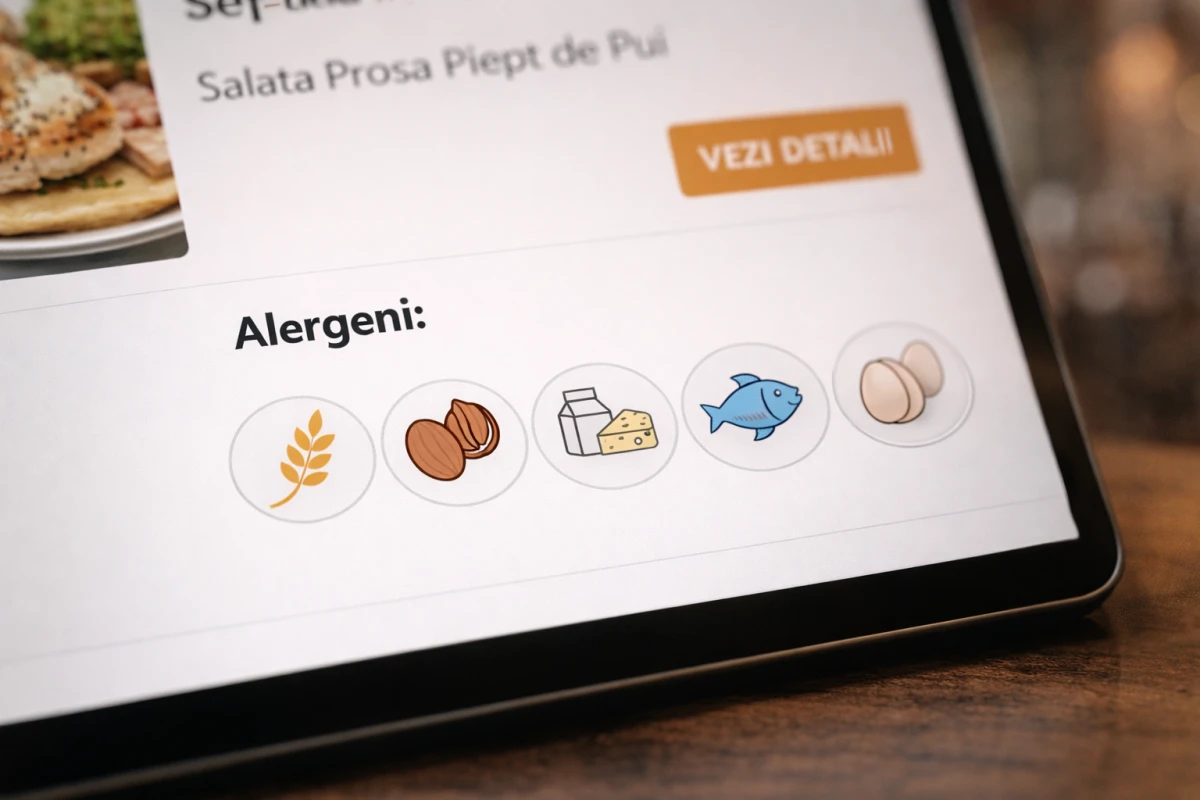
A correct digital menu must:
display allergens for each product
allow instant updates
provide visual clarity (icons, highlighting)
👉 Practically:
the information is more accessible
the risk of errors decreases
Real difference: digital vs physical menu
Aspect | Physical menu | Digital menu |
|---|---|---|
Update | difficult | instant |
Costs | high | zero |
Risk of errors | high | reduced |
Clarity | limited | very good |
Compliance | difficult to maintain | easy to control |
👉 From a legal perspective, digital menu is superior.
How Menivo automates compliance
Here we enter the practical zone — how to implement correctly without complicating operations.
1. Allergens set per product
In Menivo:
each product can have selected allergens
the list is standardized (the 14)
👉 Eliminates human errors.
2. Automatic display
The system:
displays allergens automatically in the menu
highlights them visually
👉 You no longer depend on design or printing.
3. Instant update
Change a recipe?
→ update the product
→ allergens change automatically everywhere
👉 Zero risk of outdated menu.
4. Scalability (multiple locations)
If you have:
restaurant + delivery
multiple locations
Menivo allows you:
centralized control
legal consistency
5. Customer experience
The customer sees:
clearly what the product contains
without having to ask the waiter
👉 Increases confidence and reduces stress.
Most common mistakes (and how to avoid them)
❌ 1. "We don't have dangerous allergens"
All restaurants have allergens.
❌ 2. Lack of updates
You change an ingredient → forget to modify the menu.
❌ 3. Ambiguous display
"May contain traces" is not enough.
❌ 4. Untrained staff
Waiters don't know how to respond correctly.
My recommendation (as correct implementation)
If I were to implement from scratch for a restaurant:
Standardize recipes
Define allergens per product
Use digital menu (not physical)
Automate through Menivo
Test customer experience
Do monthly audit
👉 This eliminates 90% of risks.
Conclusion
Compliance with the rules regarding food allergen restaurant legal obligations Romania is not just a legal requirement — it is a direct responsibility to the customer.
In short:
there are 14 mandatory allergens
they must be declared clearly
the law applies to restaurants too
fines are real
the risks are serious
👉 The modern solution is clear:
a well-implemented digital menu + automation.
If you want to do things "by the book", don't rely on manual solutions. Use a system that reduces human error and keeps you compliant permanently.