
How does a QR code store information?
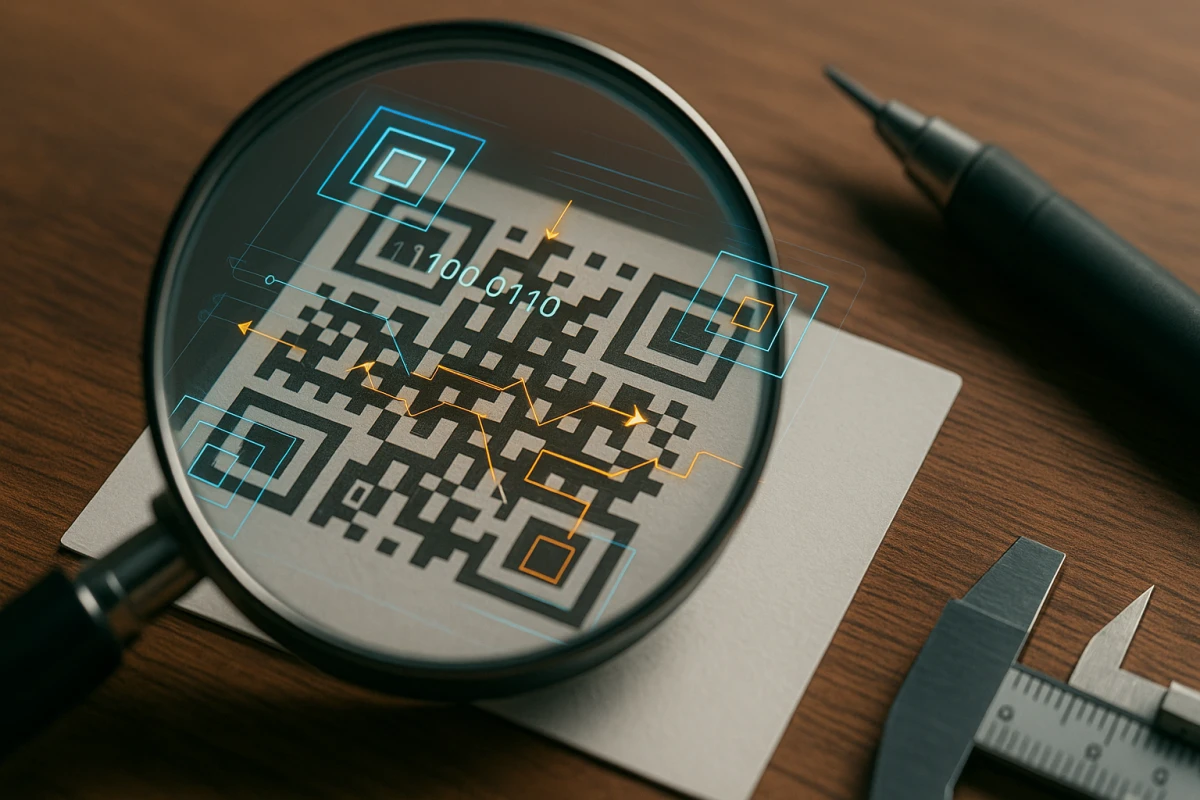
QR Code. A complex matrix of black and white squares. Although it looks like a pixelated image, each of these squares is actually a marker that serves a greater function in the information sharing capabilities of the Code.
Positioning of detection markers

Located at three corners of each code, it allows a scanner to accurately recognize the Code and read it at high speed, while indicating the direction in which the Code is printed. Essentially, these help with rapid identification of the presence of a QR code in an image and its orientation.
Alignment marks

Smaller than position detection markers, these help align QR codes drawn on a curved surface. and, the more information a Code stores, the larger it is and the more alignment patterns it requires.
Synchronization pattern

Alternating black and white patterns on the QR code with the idea of helping accurately set up the data grid. Using these lines, the scanner determines how large the data matrix is.
Version information

Currently, there are 40 different versions of QR codes, these markers specify which one is used. The most common are versions 1 through 7.
Format information

Format patterns contain information about error tolerance and the data mask pattern and facilitate code scanning.
Data and error correction keys

The error correction mechanism inherent in the structure of the QR Code is where all your data is contained, also sharing space with error correction blocks that allow up to 30% of the Code to be damaged.
Contrast area

This is similar to the importance of white space in design, that is, it provides structure and improves understanding. For whom or what can you ask? For the scanning program. To distinguish the QR code from its surroundings, the quiet zone is vital.